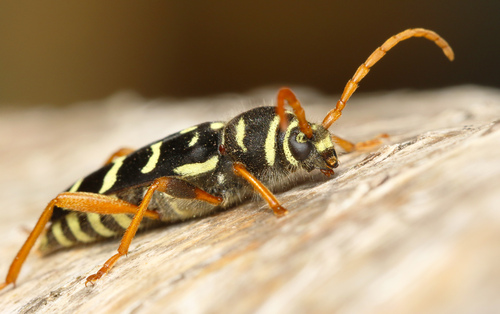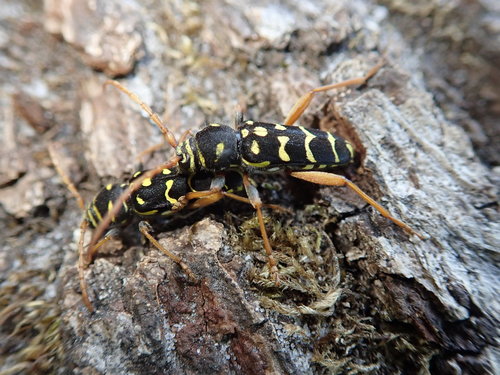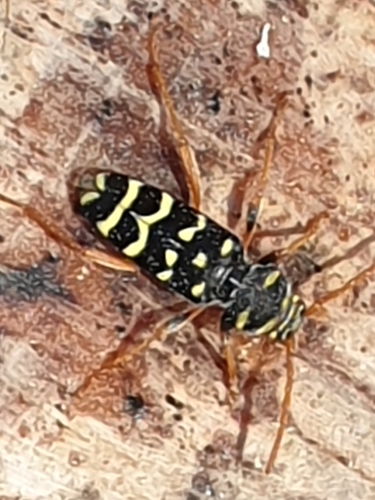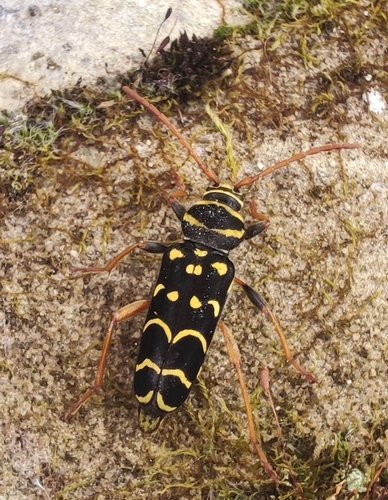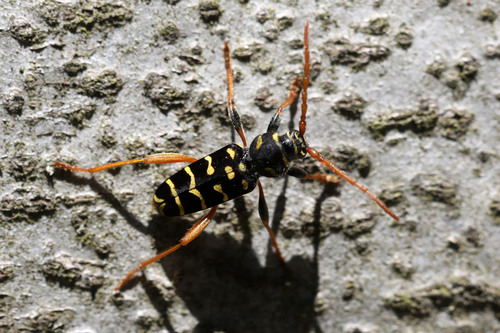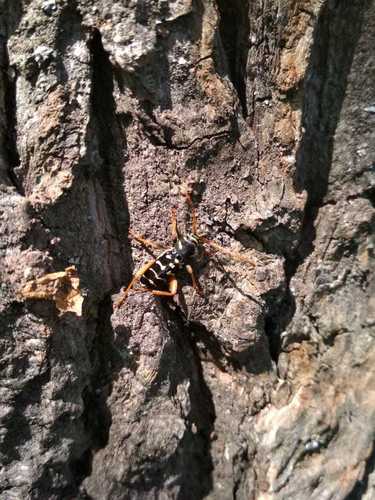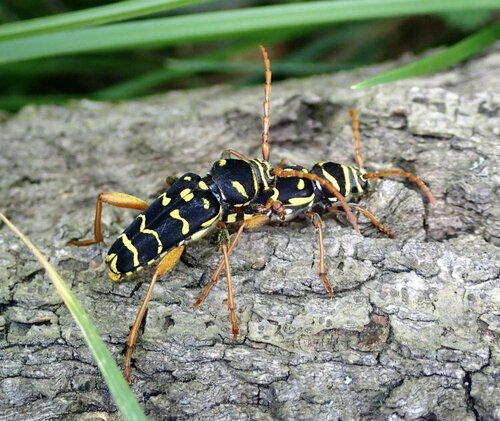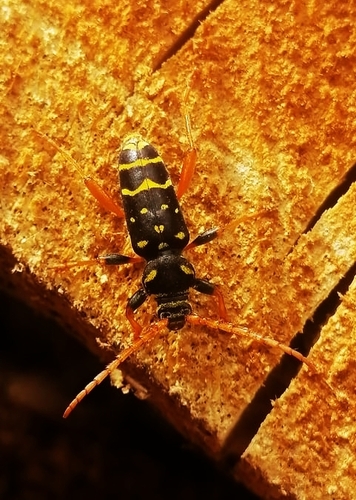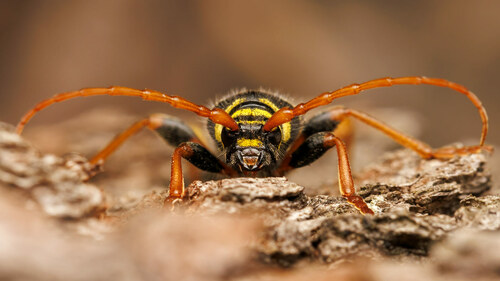
Plagionotus arcuatus (Linné, 1758)
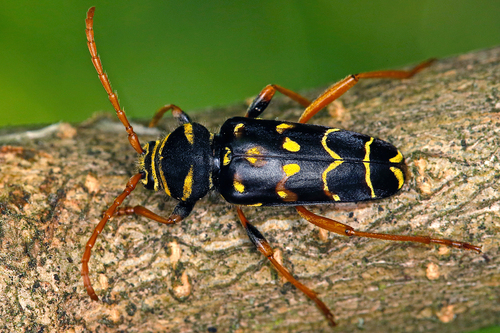
Source: Wikipedia
Synonyms 36
- 12,219 GBIF occurrences
- 1,810 iNaturalist observations
It is present in several protected areas. The species is considered Near Threatened (NT) in the German Red List (Bense et al. 2021). No conservation measures are needed. FSC Guidelines should favour the survival of the species.
This is an obligate saproxylic species. It lives in a wide variety of habitats but mostly in forests, parks in cities and rural gardens. It is polyphagous in broad-leaved trees, especially Quercus, and also in Castanea, Carpinus, Betula, Fagus, Salix, Prunus, and Robinia). Larvae develop under the bark of sun-exposed standing and dead fallen trunks and thick branches (Hoskovec et al. 2021). The life cycle takes between one or two years, with pupation in spring in the wood or sometimes in the thick bark. Adults emerge in May to July on the host plant. Pupation takes 20-30 days.In Hungary, it occurs in various deciduous forest types, mainly in oak, beech and hornbeam (O. Merkl pers. comm. 2009). In Romania, it is present in old oak forests, with clearance inside (P. Istrate pers. comm. 2009). In the UK, this species inhabited ancient forests (K.N.A. Alexander pers. comm. 2009).
This species is common almost everywhere. The population trend is at least stable in most of the species' range.In Hungary, the species is regarded as common on its localities (O. Merkl pers.comm. 2009). It used to be fairly rare in Denmark, but has become more widespread and common in the recent years (Thomsen 2007). It is considered a common species in the Transylvanian oak forests (P. Istrate pers. comm. 2009). In Ukraine, it is a common species mostly occurring in the northern half of the country. In Finland, it is rare (edge of distribution) (Heliövaara et al. 2004). In Latvia, it is rather common in the whole country except in coniferous stands where it not very abundant (D. Telnov pers. comm. 2024). It is widespread and common in France (Berger 2012). In Britain, it is thought to have been native in south-eastern England until the 19th century, with established populations formerly in Epping and Hainault Forests; there were also non-established introductions (K.N.A. Alexander pers. comm. 2009).
European regional assessment: Least Concern (LC)EU 27 regional assessment: Least Concern (LC)This beetle is listed as Least Concern in view of its wide distribution, tolerance of a degree of habitat modification, presumed overall large population and it occurs in several protected areas.
In general, human activity favours the species by creating sunny areas within the forest, and the main threats are conversion of native forest into plantations and minimum intervention management. The species is safe as soon as there are oaks and freshly dead wood in open sunny areas.In particular, this species is not threatened in Hungary because host plants are available all over its range (O. Merkl pers. comm. 2009). In Romania, it is not threatened in Transylvania, but the southern populations may be negatively affected by habitat loss (P. Istrate pers. comm. 2009). In the UK, the reason for extinction is not known, but it probably resulted from fragmentation and isolation of populations (K.N.A. Alexander pers. comm. 2009).