The beetles we name last, and the ones we never find
Across 28 veteran-oak sites from Israel to Norway, 425 saproxylic beetle species were trapped, measured and identified. Small species were described later than large ones. 14 still have no name at all. And when we asked the world's biodiversity databases where these beetles live, 84 of them — 19.8% — had nothing to say.
This edition adds nothing to the paper's findings. It re-checks them against live data, links every species to the global databases a reader can inspect for themselves, and says plainly where the re-check agrees and where it does not.
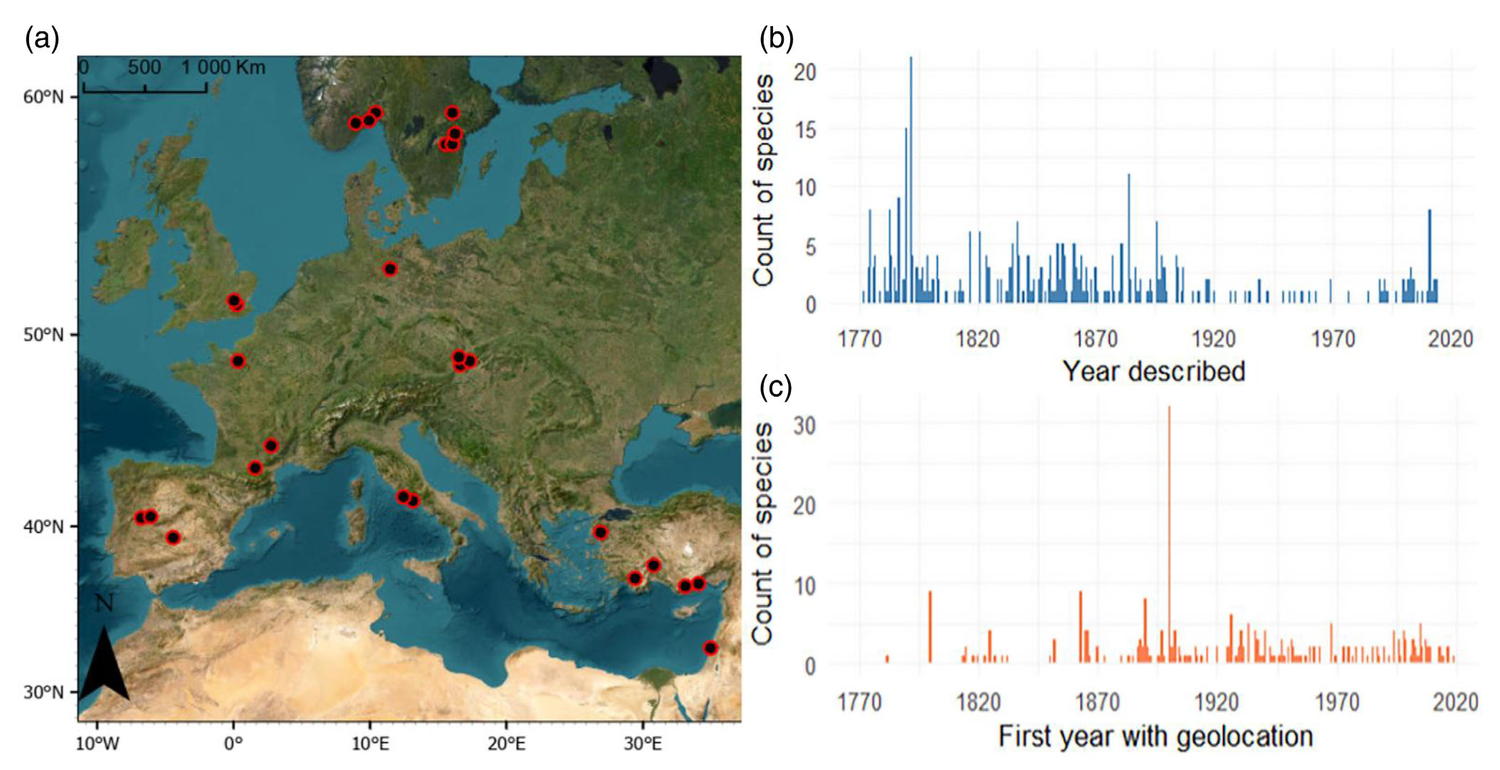
Ten countries, 28 sites, 280 old oaks
Each site contributed ten mature Quercus trees with cavities, 175–612 cm in circumference. A flight-interception trap hung on every tree, 1–7 m up and usually beside a cavity mouth, and was emptied monthly through one season between 1994 and 2012. The sites span 31.5°N to 60.0°N and 10 to 1500 m above sea level.
Which beetles, and why these
The team worked with 11 families in which identification to species is reliable across many countries and many determiners. Families where it is not — Latridiidae, Cryptophagidae, Staphylinidae — were deliberately excluded.
Those excluded families are mostly small-bodied fungus-feeders and predators: exactly the groups the paper finds hardest to detect. Leaving them out makes every bias reported here a conservative estimate.
Family counts as a table
| Family | Species | Share |
|---|---|---|
| Anobiidae | 106 | 24.9% |
| Tenebrionidae | 78 | 18.4% |
| Elateridae | 67 | 15.8% |
| Dermestidae | 55 | 12.9% |
| Histeridae | 32 | 7.5% |
| Buprestidae | 28 | 6.6% |
| Cleridae | 16 | 3.8% |
| Scarabaeidae | 16 | 3.8% |
| Mycetophagidae | 11 | 2.6% |
| Erotylidae | 10 | 2.4% |
| Lucanidae | 6 | 1.4% |
Where these species are recorded in the world
Not the study sites — the global footprint of the 425 species in GBIF, re-queried 2026-08-05. The ten study countries are outlined in orange.
1 619 639 GBIF records in total, 1 566 065 of them georeferenced, across 156 countries. Robinson projection; outlines from Natural Earth (public domain). Country shading uses a logarithmic scale because the record counts span five orders of magnitude. 30 small territories — Åland, Jersey, Liechtenstein and the like — are not drawn at this scale; between them they hold 1 785 records, 0.11% of the georeferenced total.
Top 40 countries as a table
| Country | Species recorded | Georeferenced records |
|---|---|---|
| France | 282 | 531 691 |
| Austria | 224 | 37 360 |
| Switzerland | 223 | 161 411 |
| Germany | 215 | 123 465 |
| Ukraine | 209 | 17 535 |
| Spain | 196 | 22 014 |
| Italy | 195 | 18 560 |
| Hungary | 193 | 13 280 |
| Poland | 184 | 14 684 |
| Sweden | 174 | 181 270 |
| Russia | 174 | 23 660 |
| Netherlands | 156 | 61 651 |
| Serbia | 155 | 6 527 |
| Slovakia | 151 | 2 070 |
| United Kingdom | 149 | 179 675 |
| Belgium | 133 | 9 793 |
| Denmark | 132 | 10 346 |
| Luxembourg | 129 | 3 817 |
| Estonia | 128 | 6 218 |
| Norway | 125 | 33 018 |
| Czech Republic | 117 | 6 899 |
| Romania | 114 | 3 180 |
| Finland | 112 | 21 600 |
| Greece | 110 | 2 577 |
| Bulgaria | 108 | 3 365 |
| Latvia | 105 | 1 402 |
| Croatia | 101 | 6 800 |
| Turkey | 97 | 3 393 |
| Lithuania | 89 | 1 917 |
| Portugal | 73 | 8 694 |
| United States of America | 70 | 24 347 |
| Slovenia | 52 | 2 174 |
| Belarus | 52 | 817 |
| Georgia | 49 | 427 |
| LI | 48 | 1 008 |
| Canada | 45 | 5 465 |
| AX | 45 | 322 |
| Montenegro | 38 | 358 |
| Morocco | 37 | 175 |
| Australia | 37 | 5 077 |
All 425, every one linked
Search, filter and sort the complete list, then open any row for its occurrence record, conservation status and outward links. Every one of the 425 species links to both GBIF and iNaturalist: 371 to a validated GBIF taxon page and 328 to an iNaturalist taxon page and 85 to a Catalogue of Life entry directly, and the rest to a prepared search on each site, because a name the backbone cannot resolve is exactly the name a reader will want to look up themselves. 229 species carry an openly licensed photograph. The current selection downloads as CSV with all 25 columns.
| Photograph | Details |
|---|
Body length is the mean of three male specimens, measured to 0.1 mm. Europe is the European Red List of Saproxylic Beetles (Cálix et al. 2018); GBIF geo. and 1st geo. are georeferenced occurrence counts and the earliest georeferenced year, as of 2026-08-05. Red List categories are given as their standard codes because the IUCN category colours are not distinguishable to colour-blind readers — Vulnerable and Near Threatened differ by ΔE 6.5.
Big beetles got named first
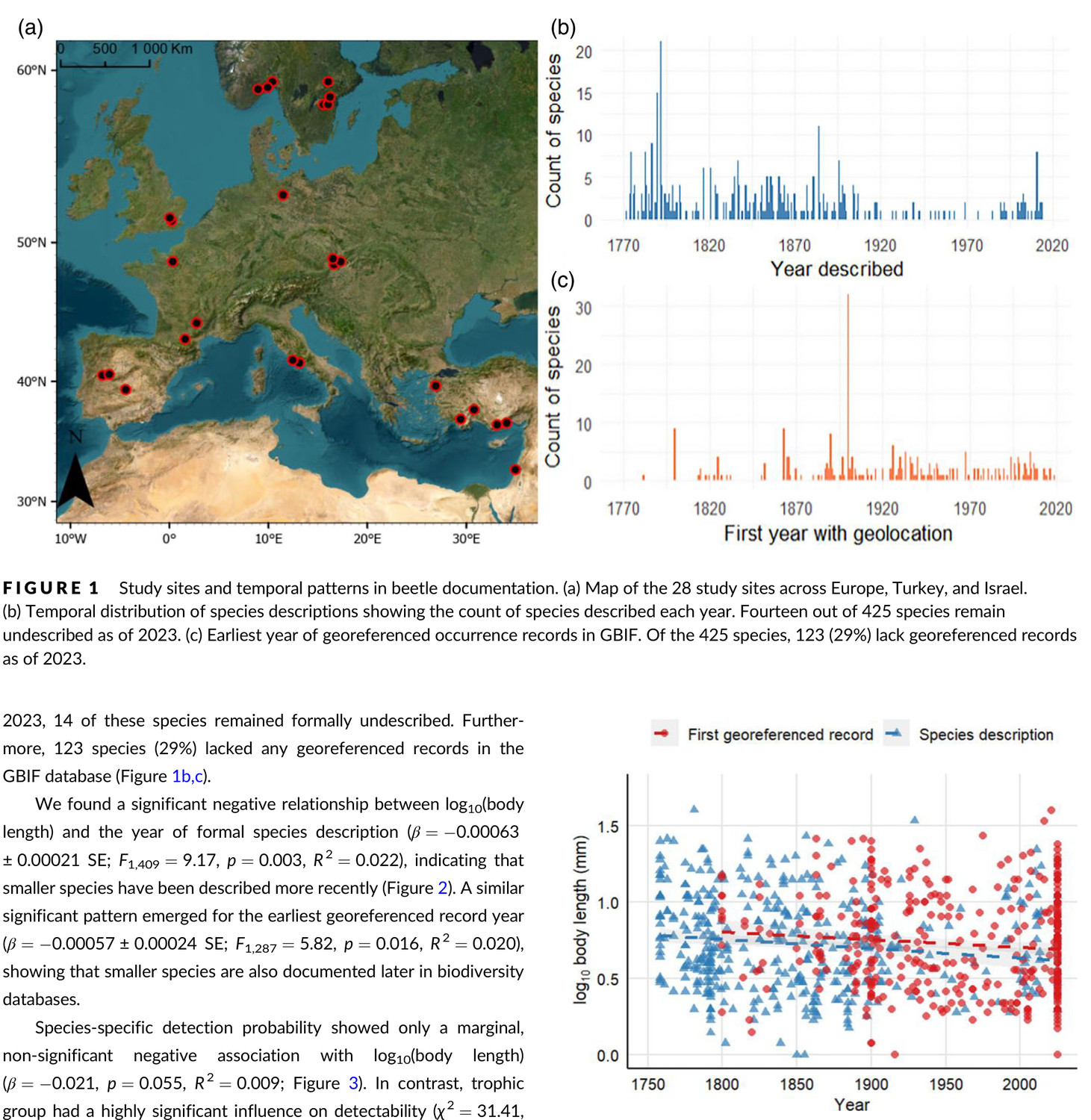
The paper's first result: body length declines with year of description. Large, conspicuous species were described in the eighteenth and nineteenth centuries; the small ones waited. If the species still waiting are the small ones too — and 14 unnamed species in this dataset average 3.2 mm against 7.1 mm for the named ones — then the Linnean shortfall is not a random gap in the catalogue. It is biased towards exactly the species hardest to see.
Body length against year of description
Every one of the 411 described species is a dot — hover for its name, or pick a guild to bring it forward. The line is the paper's own fitted slope, with the 95% interval on that slope.
See the figure as published
When each species was described
411 described species; the other 14 are still waiting for a name.
The spike either side of 1790 is the Fabrician era, when the large and obvious beetles of Europe were being named in bulk. The bars after 2000 are recent Turkish and Mediterranean descriptions — several of them by this paper's own authors.
When each first appeared on a map
Earliest georeferenced GBIF record per species, 2026-08-05.
Being named is not being found. A species can wait a century between its description and the first record anyone can put on a map — the Wallacean shortfall, which the next section takes up.
Named, but nobody knows quite where
A species can be described and still be missing from the map. When the authors queried GBIF on 30 January 2024, 123 of the 425 species — 29% — had no georeferenced occurrence record at all. That is the Wallacean shortfall: not ignorance of what exists, but of where it lives.
Two shortfalls, one cause
The species that arrive late in the catalogue are the same ones that arrive late on the map. The paper finds body length predicts the year of first georeferenced record much as it predicts the year of description — β = -0.00057 (p = 0.016, n = 289) against -0.00063 (p = 0.003, n = 411). A small beetle waits for a taxonomist, and then it waits again for a recorder.
Conservation planning inherits both delays. A species with no mapped occurrence cannot enter a distribution model, cannot be counted in a site's assessment, and cannot trigger a designation — so the fauna that is hardest to find is also the fauna that is hardest to protect, however abundant it may actually be.
What you eat matters more than how big you are
The paper's second question was whether body size predicts how likely a species is to turn up in a trap. It barely does (β = 0.021, p = 0.055). Trophic guild does (χ² = 31.41, df = 4, p < 0.001).
Detection probability by guild
Mean and 95% confidence interval, from single-season occupancy models. Only these three guilds are reported numerically in the paper.
Sapro-xylophagous beetles — the ones living in wood already softened by decay — are caught roughly 60% more often than fungus-feeders. Per-species detection probabilities were not published, so these are the paper's own summary values, not a recomputation.
Body length by guild
Box: quartiles and median. Dot: mean. Whiskers: full range. Kruskal–Wallis χ² = 57.93, df = 4, p < 0.001.
Recomputed from Table S1. All five guild means and standard deviations match the published values to two decimal places, which is what tells us the body-length and guild data behind this edition are the paper's own.
Guild statistics as a table
| Guild | n | Mean mm | SD | Median | Range | Published mean | Check |
|---|---|---|---|---|---|---|---|
| Mycetophagous | 37 | 3.85 | 1.76 | 3.6 | 1.7–11.0 | 3.85 | reproduced |
| Saprophagous | 99 | 4.10 | 2.57 | 3.4 | 2.0–16.0 | 4.10 | reproduced |
| Sapro-xylophagous | 96 | 8.55 | 6.20 | 7.3 | 1.6–26.0 | 8.55 | reproduced |
| Xylophagous | 78 | 7.99 | 9.69 | 5.2 | 1.7–65.0 | 7.99 | reproduced |
| Zoophagous | 115 | 8.43 | 5.62 | 8.0 | 0.8–34.0 | 8.43 | reproduced |
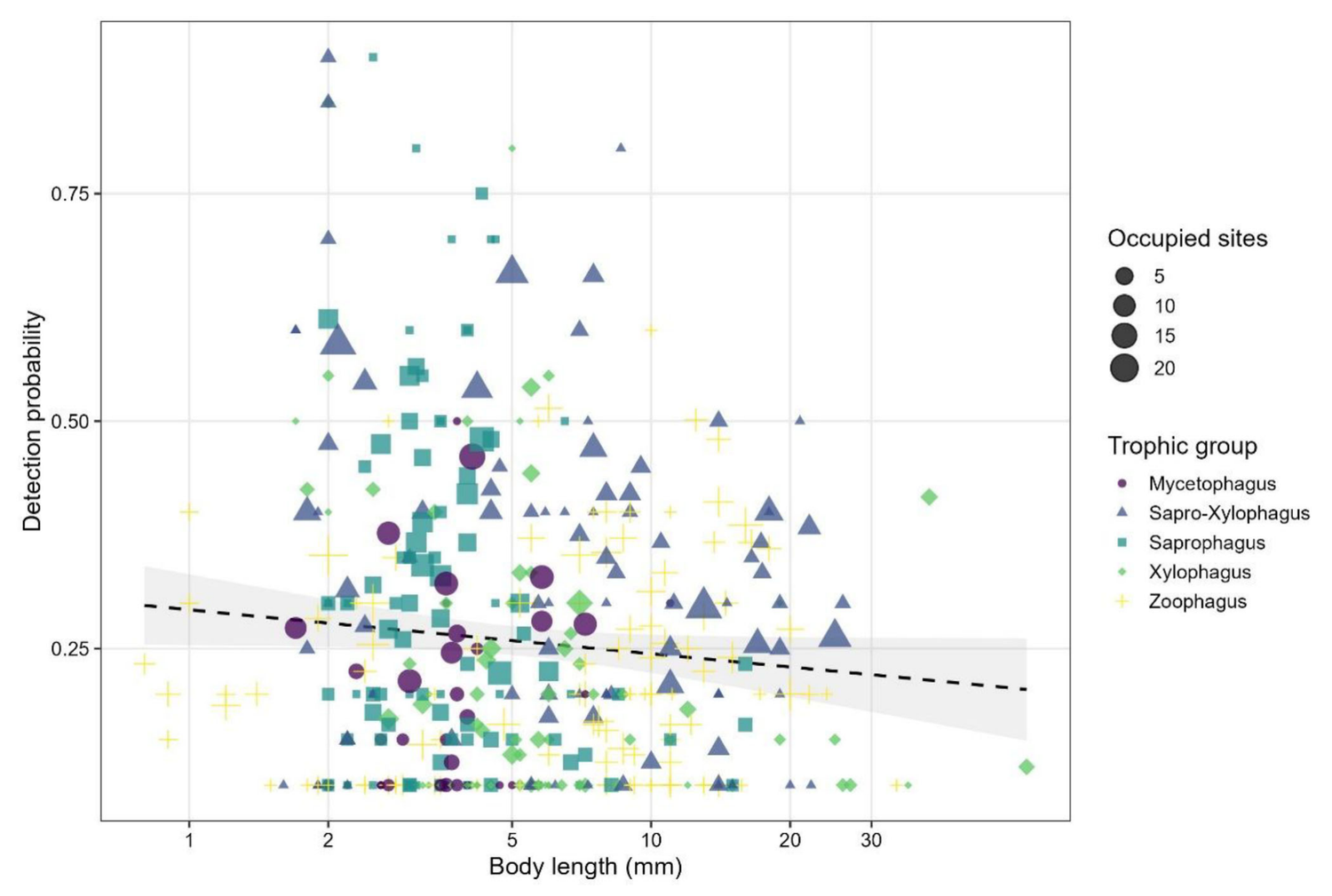
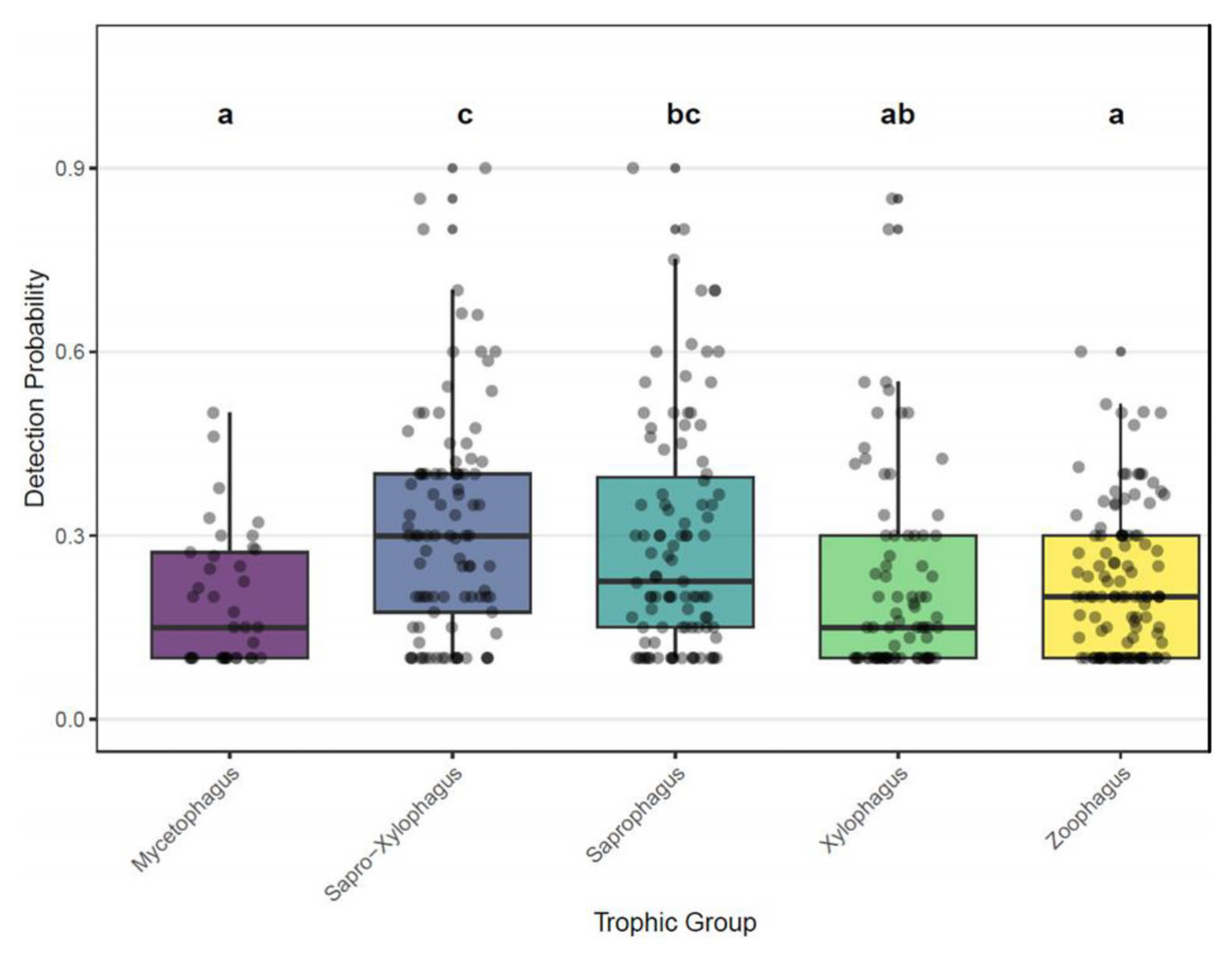
These two figures are shown as published because the underlying per-species detection probabilities are not in the archived dataset, so they cannot be redrawn.
38 of these beetles are in trouble in Europe
The paper does not report conservation status. We added it, from the European Red List of Saproxylic Beetles (Cálix et al. 2018) — the assessment that covers this fauna — and from the global IUCN Red List via GBIF.
Every threatened and Near Threatened species
European Red List category first, then EU 27. Click through to GBIF or iNaturalist for each.
| Europe | Species | Family | Guild | mm | EU 27 | Endemic to Europe | GBIF geo. records | Links |
|---|---|---|---|---|---|---|---|---|
| EN | Allecula suberina | Tenebrionidae | Sapro-xylophagous | 8.2 | EN | yes | 5 | GBIF · iNat |
| EN | Corticeus bicoloroides | Tenebrionidae | Zoophagous | 3.5 | EN | yes | 158 | GBIF · iNat |
| EN | Limoniscus violaceus | Elateridae | Saprophagous | 11.0 | EN | yes | 640 | GBIF · iNat |
| EN | Mycetochara graciliformis | Tenebrionidae | Sapro-xylophagous | 7.0 | EN | no | 0 | GBIF · — |
| EN | Podeonius acuticornis | Elateridae | Zoophagous | 7.5 | EN | no | 411 | GBIF · iNat |
| EN | Tetrigus cyprius | Elateridae | Zoophagous | 24.0 | EN | no | 1 | GBIF · — |
| EN | Triplax lacordairei | Erotylidae | Mycetophagous | 3.6 | EN | no | 462 | GBIF · iNat |
| VU | Ampedus brunnicornis | Elateridae | Zoophagous | 8.2 | VU | yes | 356 | GBIF · iNat |
| VU | Ampedus hjorti | Elateridae | Zoophagous | 10.0 | VU | yes | 1 182 | GBIF · iNat |
| VU | Hymenorus doublieri | Tenebrionidae | Sapro-xylophagous | 8.0 | VU | no | 772 | GBIF · iNat |
| VU | Ischnodes sanguinicollis | Elateridae | Zoophagous | 9.0 | VU | no | 1 319 | GBIF · iNat |
| VU | Protaetia mirifica | Scarabaeidae | Sapro-xylophagous | 19.0 | VU | no | 112 | GBIF · iNat |
| NT | Aesalus scarabaeoides | Lucanidae | Sapro-xylophagous | 6.0 | NT | no | 699 | GBIF · iNat |
| NT | Ampedus cardinalis | Elateridae | Zoophagous | 14.0 | NT | yes | 1 277 | GBIF · iNat |
| NT | Ampedus elongatulus | Elateridae | Zoophagous | 8.0 | NT | no | 4 850 | GBIF · — |
| NT | Ampedus glycereus | Elateridae | Zoophagous | 8.0 | NT | no | 4 850 | GBIF · iNat |
| NT | Ampedus nigerrimus | Elateridae | Zoophagous | 9.0 | NT | no | 4 436 | GBIF · iNat |
| NT | Brachygonus bouyoni | Elateridae | Zoophagous | 12.2 | NT | yes | 287 | GBIF · iNat |
| NT | Brachygonus megerlei | Elateridae | Zoophagous | 11.0 | NT | no | 1 835 | GBIF · iNat |
| NT | Brachygonus ruficeps | Elateridae | Zoophagous | 6.0 | NT | no | 1 177 | GBIF · iNat |
| NT | Calais parreysii | Elateridae | Zoophagous | 34.0 | NT | no | 55 | GBIF · iNat |
| NT | Cardiophorus gramineus | Elateridae | Zoophagous | 8.7 | NT | no | 1 663 | GBIF · iNat |
| NT | Corticeus fasciatus | Tenebrionidae | Zoophagous | 3.2 | NT | no | 1 252 | GBIF · iNat |
| NT | Crepidophorus mutilatus | Elateridae | Zoophagous | 14.0 | NT | yes | 306 | GBIF · iNat |
| NT | Ectamenogonus montandoni | Elateridae | Zoophagous | 12.0 | NT | no | 67 | GBIF · iNat |
| NT | Elater ferrugineus | Elateridae | Zoophagous | 20.0 | NT | no | 3 363 | GBIF · iNat |
| NT | Gnorimus variabilis | Scarabaeidae | Xylophagous | 19.0 | VU | no | 3 420 | GBIF · iNat |
| NT | Lacon lepidopterus | Elateridae | Zoophagous | 14.0 | EN | no | 300 | GBIF · iNat |
| NT | Lacon querceus | Elateridae | Zoophagous | 10.0 | VU | no | 620 | GBIF · iNat |
| NT | Lucanus cervus | Lucanidae | Xylophagous | 65.0 | NT | no | 270 720 | GBIF · iNat |
| NT | Megapenthes lugens | Elateridae | Zoophagous | 8.7 | NT | no | 438 | GBIF · iNat |
| NT | Mycetochara quadrimaculata | Tenebrionidae | Sapro-xylophagous | 4.2 | NT | no | 663 | GBIF · iNat |
| NT | Osmoderma eremita | Scarabaeidae | Xylophagous | 26.0 | NT | yes | 8 513 | GBIF · iNat |
| NT | Pentaphyllus chrysomeloides | Tenebrionidae | Mycetophagous | 3.0 | NT | no | 332 | GBIF · iNat |
| NT | Propomacrus bimucronatus | Scarabaeidae | Xylophagous | 40.0 | NT | no | 25 | GBIF · iNat |
| NT | Protaetia fieberi | Scarabaeidae | Sapro-xylophagous | 19.0 | NT | no | 3 685 | GBIF · iNat |
| NT | Pseudotriphyllus suturalis | Mycetophagidae | Mycetophagous | 2.2 | NT | yes | 387 | GBIF · iNat |
| NT | Strongylium saracenum | Tenebrionidae | Sapro-xylophagous | 15.0 | NT | no | 6 | GBIF · iNat |
Elateridae dominate this list: 21 of the 38 are click beetles, and most of those are zoophagous — predators whose larvae hunt in the wood mould of hollow trunks, a habitat that disappears with the last old trees. Codes: CR Critically Endangered, EN Endangered, VU Vulnerable, NT Near Threatened.
Every name, checked against three global registers
The paper follows Fauna Europaea, and its names are the names used throughout this edition. Each was also looked up in the GBIF Backbone Taxonomy, iNaturalist and the Catalogue of Life in August 2026, so that each species carries an outward link to all three.
Anobiidae is now Ptinidae
The largest nomenclatural change since the study is not one species but a whole family: the paper's 106 Anobiidae are today usually treated as a subfamily of Ptinidae, and GBIF carries both nodes. Trox scaber likewise moved from Scarabaeidae to Trogidae when Troginae was raised to family rank. Neither is a correction to the study — both are the classification catching up, and this edition keeps the families as the paper published them so its counts stay comparable with the article.
Where a global register now files a species under a different accepted name, that name is shown inside the species' detail panel, next to the link. The manuscript's name stays the heading. Coverage of these families in the global registers is uneven, and where a species is absent the link becomes a prepared search rather than disappearing.
How this edition was made
Pipeline
- Species list — all 425 rows parsed from the article's Table S1 (PDF), including subgeneric names, parenthetical synonym epithets and the 14 placeholder names for undescribed species. Verified against the paper's own family and guild counts.
- Taxonomy — GBIF Backbone Taxonomy via the species-match and species-search APIs, 2026-08-05. Matches validated on rank and family before use.
- Occurrences — GBIF occurrence search per accepted taxon, with
hasCoordinate=trueandhasGeospatialIssue=false, faceted by year and country. - iNaturalist — taxon lookup by binomial, retried under the current accepted name where the two differ, 2026-08-05; 328 matched, 352 951 community observations behind them.
- Catalogue of Life — name matching against release 3LR via ChecklistBank, 2026-08-05; 85 matched to a species-level usage.
- Conservation status — European Red List of Saproxylic Beetles supplement (691 assessments parsed from the published PDF) and the global IUCN category served by GBIF.
- Photographs — iNaturalist taxon photographs, taken only where the photographer released them under a Creative Commons licence; the build refuses to publish one without both a licence code and a credit.
What this edition does and does not do
- The statistics on this page are the article's own published values. The scatter draws the paper's fitted slope; nothing is re-estimated here.
- Per-species detection probabilities are not in the archived dataset, so Figures 3 and 4 are shown exactly as published.
- The 28 site coordinates are not published, so this edition does not plot them. Section 1 shows the paper's own site map; the interactive world map shows where the species are recorded globally, which is a different thing.
- Coverage of these families in GBIF, iNaturalist and the Catalogue of Life is uneven. Where a species is absent from a register, its link becomes a prepared search on that site.
- Names follow the article. Where a register currently uses a different accepted name, that is noted inside the species' detail panel and nowhere else.
- Red List categories are shown as codes. IUCN's own category colours fail colour-blind separation (Vulnerable against Near Threatened measures ΔE 6.5, well under the 15 needed), so the tints only reinforce a code that is always present as text.
- GBIF occurrence counts include records identified to subspecies under an accepted species.
Cite the science, not this page
Franzén, M., Jansson, N., Avci, M., Brin, A., Brustel, H., Budka, J., Buse, J., Carpaneto, G., Chiari, S., Čížek, L., Coskun, M., Dagley, J., Hammond, P.M., Micó, E., Öncül Abacıgil, T., Pavlíček, T., Schlaghamerský, J., Šebek, P., Sverdrup-Thygeson, A., Varli, S.V., Westerberg, L., Wilde, I., Zauli, A. & Milberg, P. (2026) Taxonomic and methodological biases in saproxylic beetles: Body size, trophic group and detection probability. Insect Conservation and Diversity, 1–8. doi:10.1111/icad.70122