
Aims
Wooded meadows are species-rich seminatural grasslands historically maintained by haymaking and selective retention of scattered trees, but have largely been abandoned or afforested across northern Europe. We describe how the field layer changed over a century after abandonment.
Location
Southern Sweden.
Methods
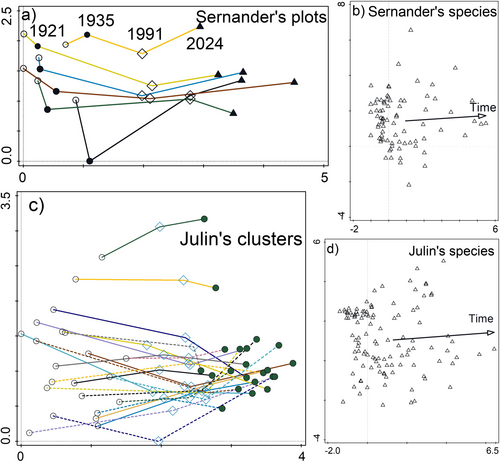
We quantified century-scale changes in field-layer vegetation (1921–2024) in permanent plots within a wooded meadow, protected in 1923 and left to undergo natural succession without management. One cohort of six plots was established in 1921 and another with 22 in 1937.
Results
Pooled species richness across the two plot systems declined by about 70% over the study period, from a mean of 89 species in the initial surveys to 26 species in 2024, with the steepest losses occurring early in succession. Ordination analyses showed that this decline was driven by directional compositional change associated with canopy closure, with grassland specialists (Trifolium pratense, Rhinanthus minor) showing strongly negative ordination scores (< −0.7); light-demanding species had 2.7 times higher odds of local extinction per unit increase in light index. The main winners were not classic shade-tolerant understorey herbs, but spring geophytes (Anemone nemorosa, Convallaria majalis) that complete their annual life cycle before canopy leaf-out, suggesting that vernal phenology and temporal niche partitioning underpin survival under closed deciduous canopies.
Conclusion
Meadow abandonment triggers a rapid loss of grassland species, while few forest specialists colonise despite a century of succession. The understorey remains species-poor, dominated by spring geophytes that escape shade through early phenology rather than tolerating it. Such century-scale unmanaged trajectories are rare, essential for understanding successional dynamics, and merit protection from intervention.