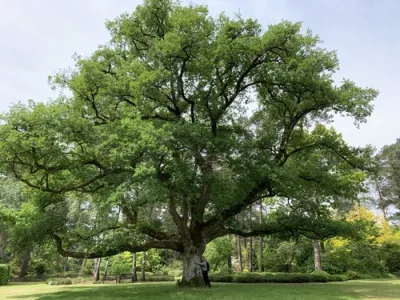
Veteran oaks in Östergötland could become substantially more numerous over the coming decades. A new study in Biological Conservation projects an increase of about 61%, from an estimated 6,200 trees in 2016 to nearly 10,000 around 2070. However, more large trees do not automatically secure the future of the species that depend on them.
Per Milberg, Markus Franzén and Victor Johansson traced 35 large oaks documented in Vårdnäs parish in the 1950s. Annual mortality over the period to 2012 was around 0.45%. The researchers combined these observations with published growth and mortality estimates and a county-wide inventory of 18,260 large oaks to model future changes.
The projected rise comes mainly from trees already approaching the study’s veteran threshold of four metres in trunk circumference. Within the modelled population, numbers peak around 2070 and then begin to decline. Smaller oaks were not included, so the study cannot establish whether younger generations will sustain veteran numbers beyond the projection period.
More trees would not eliminate spatial gaps: around 13% of veterans are projected to have no other veteran within 500 metres in 2076. The authors recommend retaining existing veterans, securing younger replacement trees and encouraging future veterans where they can improve connections across the landscape. Large-tree numbers alone are not enough: newly qualifying veterans do not necessarily provide the same habitats as the oldest trees.
Read the research
Milberg, P., Franzén, M. & Johansson, V. (2026). Dynamics of veteran oaks: Great expectations for southern Sweden? Biological Conservation, 324, 112130.