The first course of the semester for the new Master’s students in Ecology and Sustainable Development at Linköping University has officially wrapped up. Conservation Biology Methods: Field Techniques and Mapping (NBID87) ended on 30 October after a autumn out in the field.
During the course the students tried modern field tools, hula-hoop plots, surveyed oak pastures and grasslands in Östergötland, spent a field week at Station Linné on Öland and visited Nordens Ark. They went on excursions with local experts and also led their own. On 15 and 16 October, as their field examination, three student groups guided the class through their sites at Öna, Ösjömåla and Grönberget.
By the end of the course the class had reported 873 records of 543 taxa to Artportalen, the Swedish species observation system. Many are species of conservation interest, and 103 of the taxa are on the Swedish Red List 2025. The records have not been validated yet, and more reports are still coming in.
The last two excursions were among the highlights of the course. On 29 October we visited the island of Eknön, and on 30 October the ravine in Lillören nature reserve. Both days are described below.
Old oaks and bark lichens on Eknön
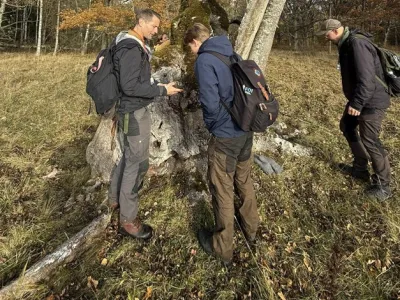
Eknön lies at the mouth of Slätbaken accessible only by boat. Guided by Ola Hammarström through grazed woodlands, old oaks, and hollow trees, students got up close with the local ecology, with nearly every stop calling for a hand lens against the bark looking for lichens.
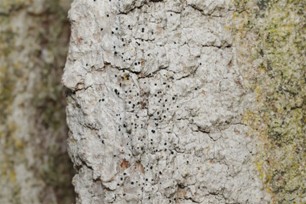
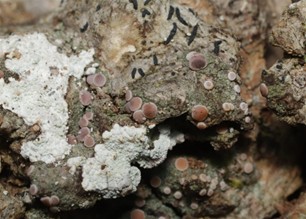
The day gave 111 records of 72 taxa, 27 of them red-listed. Stor sönderfallslav (Bactrospora dryina), an endangered lichen of old oaks, was the species we most hoped to see, and we found it at Notuddeholmen. Rosa lundlav (Bacidia rosella, vulnerable) turned up again close to where it was last reported in 2016. Another find was the Ekspik (Calicium quercinum, vulnerable), that had no public record from the island since 1995.
Some of the smallest finds are among the rarest. Lavsammetsmögel (Taeniolella arthoniae) is a parasitic fungus that grows on the fruit bodies of a few crust lichens. Artfakta lists only 22 observations of it in Sweden.
A humid ravine in Lillören
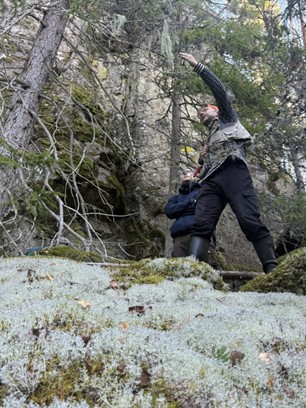
The next day Mikael Hagström took us into Lillören nature reserve in Kinda. The ravine is steep and shaded, with old spruce, fallen trunks left to rot and damp rock walls above a stream. Here we talked about forest continuity, dead wood and the humid air that many of the species need.
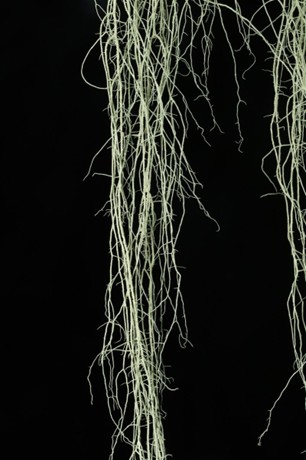
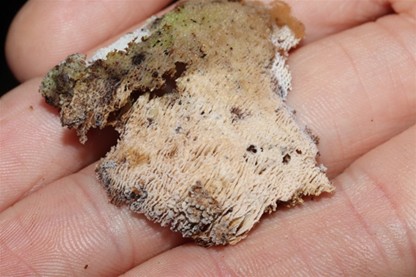
We reported 60 records of 50 taxa, 11 of them red-listed. The highlight was trådbrosklav (Ramalina thrausta, endangered), a pale hanging lichen of very humid forest. Gropig skägglav (Usnea barbata) and slitsporing (Steccherinum pseudozilingianum) are both classed as vulnerable. Slitsporing, a wood fungus, has only ten reported observations in Sweden. Klippkaka (Dendrographa latebrarum), a lichen of shaded rock overhangs, has fewer than a hundred.
The two sites need very different management. Eknön depends on grazing and on care for its old trees. In Lillören the forest is best left alone, and the stream is what matters most.
Thanks to Ola Hammarström, Mikael Hagström and Magnus Wadstein for the excursions, and to all students for a good autumn in the field.