What happens when a species-rich wooded meadow is left unmanaged for a century? A new study in Applied Vegetation Science follows vegetation change at Vessers Udde in Östergötland, revealing substantial losses of meadow plants that were not offset by the arrival of forest species.
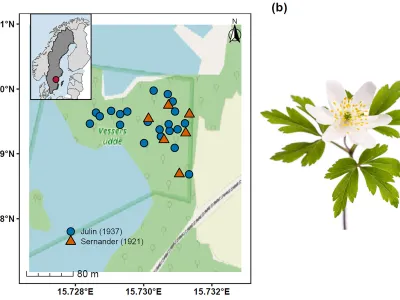
Per Milberg, Markus Franzén and Victor Johansson revisited permanent vegetation plots first surveyed in 1921 and the 1930s. The former hay meadow was protected in 1923 and allowed to develop without management. By the latest survey in 2024, the total number of recorded plant species in the two plot systems had fallen from 74 to 16 and from 104 to 35, a reduction of 66–78% .
Light-demanding meadow species were especially likely to disappear, while wood anemone (Anemone nemorosa) and lily-of-the-valley (Convallaria majalis) increased. The authors suggest that early-season growth helps these plants exploit light before the tree canopy leafs out. Yet even after decades of forest development, colonisation by forest specialist species remained limited.
Despite the losses, the authors argue against clearing vegetation at this particular reserve. Its century-long unmanaged history gives it exceptional scientific value as a reference for understanding natural succession. Maintaining that record offers insights that short-term studies cannot provide.
Read the research
Milberg, P., Franzén, M. & Johansson, V. (2026). Ecology of abandonment: meadow field layer vegetation after a century of overgrowth. Applied Vegetation Science, 29, e70090.